As a global financial epicenter, Shanghai is constantly redefining its skyline and its competitive edge. In this dynamic environment, a powerful new mandate is emerging that goes beyond mere architectural ambition. The future of work is being built on a foundation of sustainability, fundamentally reshaping what constitutes a prime workspace. Driven by robust government policies and a surging demand for healthier, more responsible corporate environments, green workspaces are no longer a niche trend but a critical component of business strategy. This evolution reflects a deeper understanding that the long-term viability of a business is intrinsically linked to the well-being of its people and the planet. This article explores the key pillars of this green revolution in Shanghai’s commercial real estate, from policy and certifications to the human-centric designs that are setting new global standards.
The policy push for green buildings
At the heart of Shanghai’s transformation is a strong and clear regulatory framework. The municipal government has taken a proactive stance, establishing local green building regulations that set a high bar for new construction. These aren’t merely suggestions; they are mandates that are systematically elevating the city’s building stock. The regulations stipulate that all new civil buildings must achieve a minimum one-star green building rating, effectively eliminating unsustainable construction practices from the outset. For state-funded projects and large-scale public buildings, the requirement is even more stringent, demanding the highest three-star rating. This top-down approach ensures that the city’s future developments are aligned with its ambitious low-carbon goals. This policy push is a clear signal to developers and investors that sustainability is a non-negotiable aspect of operating in the city’s commercial real estate market, creating a ripple effect that influences everything from material sourcing to long-term operational strategies.
Beyond compliance: The rise of international certifications
While local regulations provide a crucial baseline, the market’s ambition extends far beyond simple compliance. A growing number of developers and corporations are pursuing globally recognized certifications to signal their commitment to the highest standards of sustainability and employee well-being. Shanghai has become a leader within China for projects certified under programs like Leadership in Energy and Environmental Design (LEED) and the WELL Building Standard. Iconic structures such as the Shanghai Tower, which holds LEED Gold and Platinum certifications, serve as powerful symbols of this trend. These international standards are increasingly viewed not as an expense, but as a critical investment. They provide a trusted, third-party verification of a building’s performance, offering a competitive advantage in a crowded market. For multinational corporations, a LEED or WELL certified office is often a prerequisite, aligning with their global corporate social responsibility (CSR) commitments and brand values. This demand for certified spaces is transforming the development landscape, pushing architects and designers to innovate and integrate sustainable features from the earliest stages of planning.
The tangible returns of sustainable design
The business case for developing green workspaces is perhaps the most powerful driver of all. Sustainable buildings are proving to be more profitable, more desirable, and more resilient. The initial investment in green technologies and materials is consistently offset by significant long-term operational savings through reduced energy and water consumption. Furthermore, a clear ‘green premium’ has emerged in the marketplace. Studies have shown that LEED-certified Grade A office buildings can command higher rental rates and boast lower vacancy rates compared to their non-certified counterparts. In a competitive tenant-favorable market like Shanghai, a green certification becomes a powerful differentiator, attracting high-caliber tenants who are themselves under pressure to improve their environmental footprint. The government has further sweetened the deal by offering financial incentives, including subsidies and preferential loan policies for projects that achieve high green ratings, making the decision to build sustainably an astute financial strategy as well as an ethical one.
Biophilia: Integrating nature for employee well-being
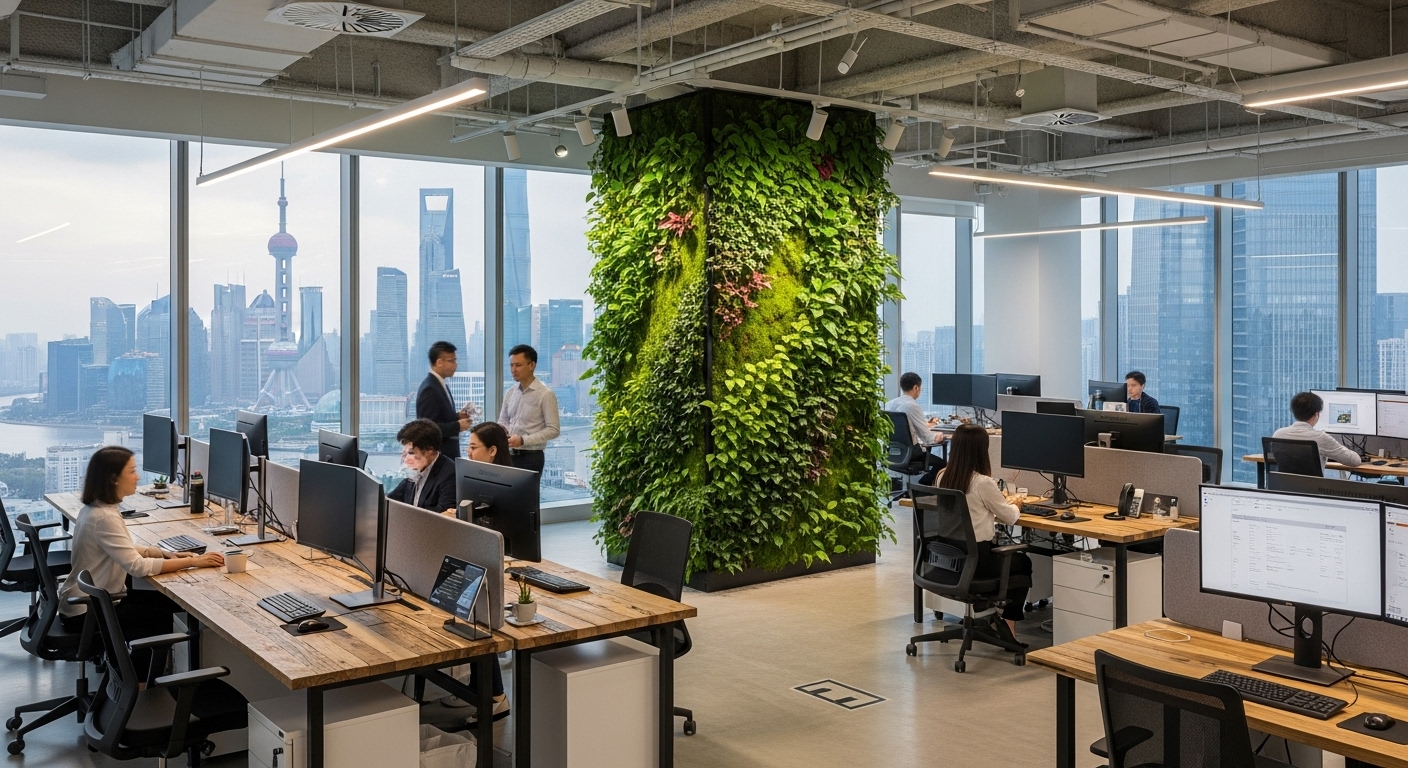
The green mandate extends beyond energy efficiency and into the very fabric of the human experience at work. A key component of modern sustainable design is biophilia, the concept that humans have an innate need to connect with nature. Workspaces are being transformed into healthier, more inspiring environments through the integration of natural elements. This includes maximizing natural light, incorporating living green walls, placing abundant indoor plants, and using natural materials like wood and stone. The benefits are tangible and well-documented; exposure to nature, even indoors, is proven to reduce stress, enhance cognitive function, and boost creativity. Companies are discovering that an investment in a biophilic environment is an investment in their most valuable asset: their people. Offices designed with these principles report higher levels of employee satisfaction and productivity, making biophilic design a crucial tool in the war for talent. It’s a recognition that a truly sustainable workspace must sustain not only the environment but also the people within it.
Smart technology as a cornerstone of sustainability
Technology is the critical enabler that brings many sustainable design ambitions to life. Smart building systems are the intelligent nerve center of the modern green office, working silently in the background to optimize performance and enhance occupant comfort. Advanced sensors continuously monitor indoor air quality, adjusting ventilation to ensure a healthy environment free from pollutants. Intelligent lighting systems mimic natural daylight patterns, which helps regulate employees’ circadian rhythms, reduce eye strain, and improve mood, all while minimizing energy consumption. Smart HVAC systems ensure optimal thermal comfort while preventing energy waste in unoccupied zones. In the commercial properties of Shanghai, the integration of these technologies is becoming standard practice in new premium developments. This data-driven approach to building management allows for continuous improvement, ensuring that the workspace is not only sustainable by design but also in its day-to-day operation, creating an environment that is both efficient and exquisitely responsive to the needs of its inhabitants.
Embracing the circular workplace model
The most forward-thinking approach to sustainability in workspaces adopts principles from the circular economy. This model moves beyond the traditional linear ‘take-make-dispose’ mindset and focuses on creating systems that are regenerative by design. In a circular workplace, resources are kept in use for as long as possible, extracting the maximum value from them whilst in use, then recovering and regenerating products and materials at the end of each service life. This translates into prioritizing recycled and upcycled materials in construction and furnishings, such as using reclaimed wood for feature walls or carpets made from recycled fibers. It also means designing for adaptability and disassembly, creating flexible layouts that can be easily reconfigured without the need for costly and wasteful demolition. By minimizing waste, reducing the consumption of virgin materials, and designing for longevity, the circular workplace represents the next frontier in sustainable design, ensuring that the built environment contributes positively to the broader ecosystem.
The message from the market, policymakers, and the workforce is unanimous: sustainable workspaces are the new standard for excellence. This is not a fleeting trend but a fundamental, long-term shift in how we define the purpose and value of the office. The convergence of stringent government policy, a clear business case, and a heightened focus on employee well-being has created a powerful momentum. For businesses operating in Shanghai, embracing this green mandate is no longer optional; it is essential for attracting top talent, meeting corporate responsibility goals, and securing a competitive advantage. By pioneering these integrated ecosystems of sustainability, technology, and human-centric design, the city is not just building greener offices—it is architecting the future of work itself and setting a benchmark for other global hubs to follow.