The modern office is undergoing a profound transformation. No longer just a physical space for work, it’s evolving into a dynamic, responsive ecosystem powered by a vast network of interconnected technologies. The shift towards hybrid models and a greater emphasis on employee well-being has accelerated this change, moving the concept of the ‘smart office’ from a futuristic ideal to a present-day necessity. This evolution is about creating a truly connected workplace, where technology, physical space, and people converge to enhance efficiency, foster collaboration, and improve the overall work experience. This guide provides a practical look at how businesses can integrate smart office technology, exploring the foundational role of the Internet of Things (IoT), the analytical power of Artificial Intelligence (AI), the tools enabling seamless hybrid work, and the critical considerations for security and implementation. We’ll delve into a strategic approach for bringing these elements together to build an office that is not just intelligent, but also intuitive and human-centric.
The foundational layer: leveraging IoT for a responsive environment
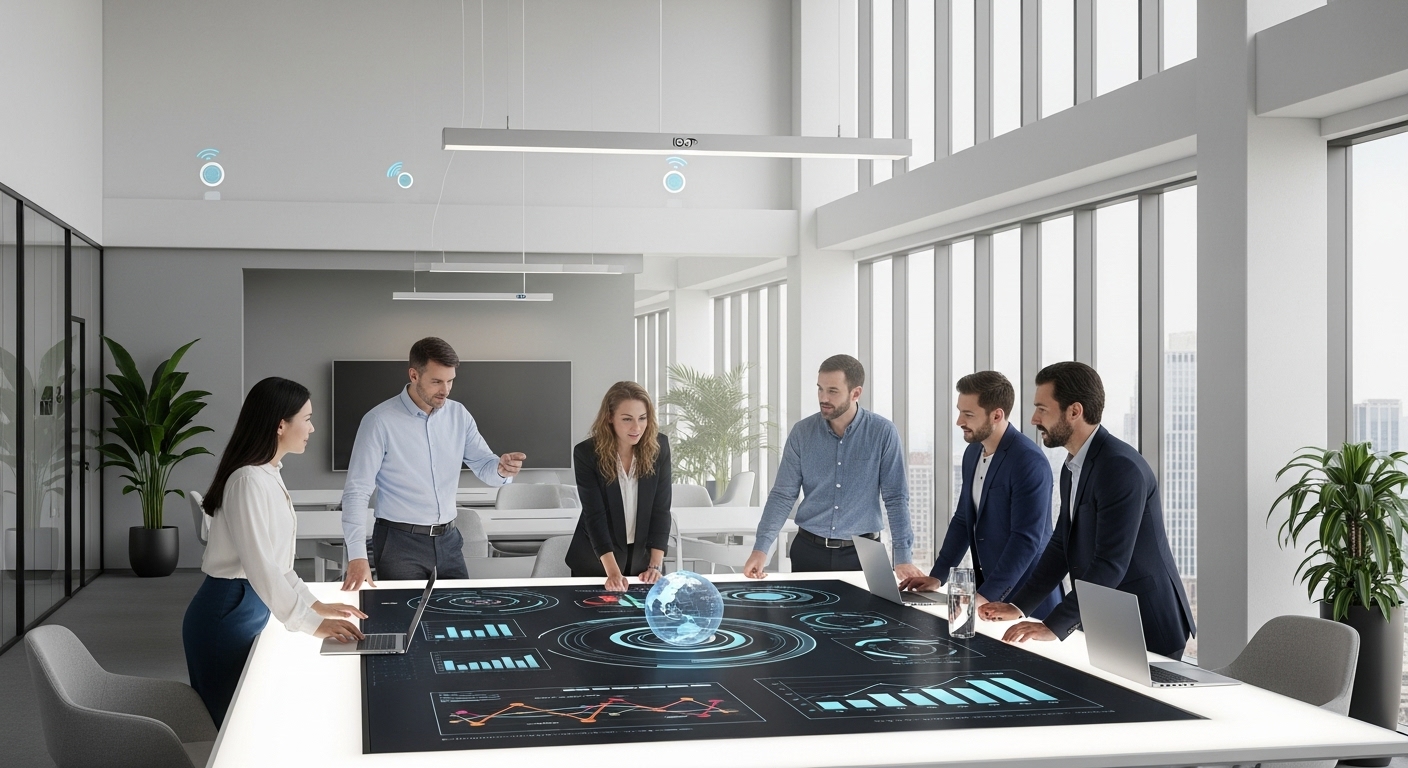
The Internet of Things (IoT) forms the central nervous system of any smart office. It is the network of interconnected sensors, devices, and systems that gather real-time data about the physical workspace, creating an environment that can adapt and respond to the needs of its occupants. The most immediate and tangible application of IoT is in building management. Smart sensors can monitor room occupancy, automatically adjusting lighting and HVAC (heating, ventilation, and air conditioning) systems. When a meeting room is empty, lights and air conditioning can be turned off, leading to significant energy savings and a reduced carbon footprint. According to recent studies, smart building controls can reduce energy consumption by up to 30%. Beyond climate and lighting, IoT sensors provide invaluable data on space utilization. By understanding which desks, meeting rooms, and common areas are most frequently used, businesses can make informed decisions about office layout and design, eliminating underutilized space and creating more of the collaborative zones that employees need. This data-driven approach ensures the office layout supports actual work patterns, rather than being based on assumptions. Furthermore, IoT contributes to a healthier workplace by monitoring environmental factors like air quality, humidity, and CO2 levels, making automatic adjustments to ventilation to maintain a safe and comfortable atmosphere for everyone.
The intelligence engine: using AI to optimize and personalize
If IoT is the nervous system that collects data, Artificial Intelligence (AI) is the brain that analyzes it and makes intelligent decisions. AI and machine learning algorithms process the vast amounts of data generated by IoT sensors to uncover patterns, predict needs, and automate complex processes. One of the most powerful applications is in workspace optimization. AI can analyze historical and real-time space utilization data to predict future needs, helping facility managers allocate resources more effectively and even suggest optimal office layouts. For employees, AI offers a layer of personalization that was previously impossible. AI systems can learn individual preferences for lighting, temperature, and even desk height, automatically adjusting a hot-desking station to a specific user’s saved profile upon their arrival. This removes friction from the daily experience and creates a more comfortable, tailored environment. Another critical role for AI is in predictive maintenance. By monitoring the performance of office equipment, from printers to HVAC systems, AI can detect subtle anomalies that indicate a potential failure. It can then automatically schedule maintenance before a breakdown occurs, minimizing disruption and costly downtime. As one report on workplace technology highlights:
By 2025, a majority of companies will be using AI-driven workplace analytics to improve employee experience and productivity.
This demonstrates a clear trend towards using AI not just for operational efficiency, but as a tool to actively enhance the human experience at work.
Bridging the gap: advanced tools for hybrid collaboration
In the era of hybrid work, the connected workplace must extend beyond its physical walls. Smart office technology plays a crucial role in bridging the gap between in-office and remote employees, ensuring seamless communication and equitable collaboration for all. This is achieved through a suite of integrated tools designed for the modern, distributed team. Smart booking systems for desks and meeting rooms are essential. These platforms, often powered by AI, allow employees to easily find and reserve available spaces through a mobile app, preventing scheduling conflicts and wasted time. They also provide valuable data on office attendance patterns, helping leadership understand when and how the office is being used. In meeting rooms, next-generation video conferencing hardware with features like intelligent cameras that automatically frame the active speaker and high-fidelity audio systems ensure that remote participants feel fully present. Interactive smartboards and digital whiteboards allow real-time, collaborative brainstorming sessions where both in-person and remote team members can contribute equally. The content from these sessions can be instantly saved and shared, creating a persistent digital record of the collaboration. A truly integrated system will connect these tools, allowing an employee to book a room, have the video conference automatically start at the scheduled time, and share content from the smartboard with all attendees with just a few clicks.
Securing the connected office: balancing access and protection
As offices become more interconnected, they also become more vulnerable to cyber threats. A comprehensive security strategy is paramount in a connected workplace, balancing the need for seamless access with robust protection of sensitive data and physical assets. Smart security starts at the entrance with modern access control systems. Instead of traditional keycards, companies are adopting mobile-credential or biometric-based systems that offer greater security and convenience. These systems can grant temporary access to visitors and can be instantly revoked if a device is lost or an employee leaves the company. Within the office, integrated security cameras with AI-powered video analytics can detect unusual activity in real-time and alert security personnel. However, the biggest challenge lies in data privacy. A smart office collects a significant amount of data, from room occupancy to individual employee preferences. It is critical for organizations to be transparent with their employees about what data is being collected and how it is being used. Establishing clear data governance policies and ensuring all IoT devices and platforms are secure from hacking is non-negotiable. This involves regular security audits, secure network protocols, and employee training on cybersecurity best practices. The goal is to create a secure environment without infringing on employee privacy or creating a sense of being constantly monitored, which could erode trust and morale.
From concept to reality: a roadmap for smart tech integration
Successfully transforming a traditional office into a connected workplace requires a clear strategic roadmap, not just a piecemeal adoption of new gadgets. The first step is to define clear objectives. What does the organization hope to achieve? Is the primary goal to reduce energy costs, improve space utilization, enhance employee collaboration, or all of the above? These goals will dictate the technology choices. A phased approach is often the most effective. Start with foundational technologies that offer a high return on investment, such as smart lighting and HVAC controls. This allows the organization to demonstrate value and secure buy-in for more advanced projects. Addressing the challenge of interoperability is crucial. Many smart devices from different manufacturers don’t naturally work together. Choosing platforms and technologies that are built on open standards can prevent being locked into a single vendor’s ecosystem and ensures that new technologies can be integrated in the future. It is also essential to involve employees throughout the process. Conduct surveys to understand their pain points and preferences. Offer training on how to use new tools effectively and communicate the benefits clearly. Technology is only effective if people are willing and able to use it. Finally, organizations must budget not only for the initial implementation but also for ongoing maintenance, software updates, and potential upgrades to ensure the connected workplace remains effective and secure over the long term.
Measuring success: the tangible ROI of a smart office
Investing in smart office technology requires a significant capital outlay, and business leaders rightfully expect to see a clear return on that investment (ROI). The good news is that the benefits of a connected workplace are measurable and multifaceted, impacting everything from operational costs to employee retention. The most direct ROI comes from operational efficiencies. Smart energy management systems can demonstrably reduce utility bills. Data-driven space optimization can lead to reduced real estate costs, as companies can achieve more with a smaller physical footprint. Predictive maintenance reduces repair costs and minimizes productivity losses caused by equipment failures. Beyond cost savings, the ROI is evident in productivity and performance gains. By automating routine tasks like booking rooms or adjusting thermostats, smart technology frees up employees to focus on higher-value work. An optimized, comfortable, and seamless work environment reduces friction and frustration, leading to higher levels of engagement and output. Perhaps the most critical, though sometimes harder to quantify, ROI is in talent attraction and retention. A modern, technologically advanced workplace is a powerful differentiator in a competitive job market. It signals that a company is forward-thinking and invested in its employees’ well-being and experience. Higher employee satisfaction and lower turnover rates translate into significant long-term savings on recruitment and training costs. By tracking metrics across these areas—energy bills, space utilization rates, employee productivity surveys, and staff turnover—organizations can build a powerful business case for their smart office investment.
In conclusion, the development of a connected workplace is a strategic imperative for businesses looking to thrive in the future of work. It’s about creating an environment that is more than just a collection of smart gadgets; it’s about building an integrated ecosystem where IoT provides the data, AI delivers the intelligence, and advanced collaboration tools empower a distributed workforce. By carefully planning the integration of these technologies, with a steadfast focus on security and the employee experience, organizations can unlock tremendous value. The journey from a traditional office to a truly connected workplace is an investment in efficiency, productivity, and sustainability. Most importantly, it is an investment in people, creating a workspace that is more responsive, supportive, and empowering for everyone. The future of the office is not just smart; it is a seamless and intelligent partner in the work we do.