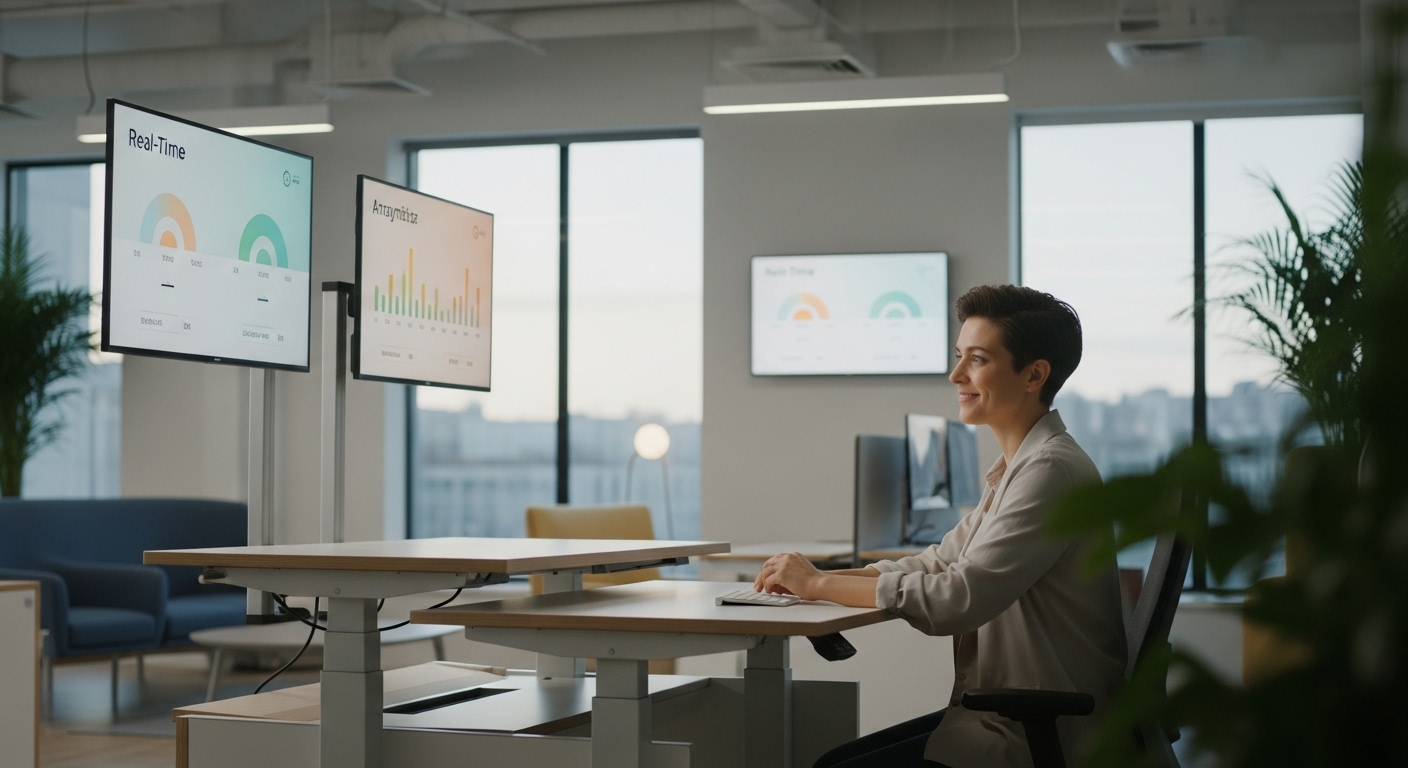
Imagine an office that doesn’t just house you, but anticipates you. A workspace that adjusts the lighting for your optimal focus, books a meeting room before you realize you need one, and purifies the air based on real-time occupancy. This isn’t a futuristic fantasy; it’s the reality of the predictive workplace. Driven by the fusion of artificial intelligence (AI) and the Internet of Things (IoT), smart office technology is evolving from simple automation to creating deeply personalized, responsive, and employee-centric environments. As businesses navigate the demands of hybrid work and a renewed focus on employee well-being, this intelligent evolution is becoming a cornerstone of the future of work. This article explores the core technologies behind the predictive workplace, its profound impact on productivity and well-being, and how it’s creating more sustainable and secure corporate ecosystems.
The evolution from automated to predictive spaces
The concept of a smart office has been with us for years, but its definition is undergoing a significant transformation. The first wave was about automation—lights that turn on with motion sensors, or automated heating schedules. While efficient, these systems were fundamentally reactive and one-size-fits-all. The predictive workplace represents a paradigm shift. It moves beyond simple triggers to create an ecosystem that learns, adapts, and anticipates the needs of its occupants. This is made possible by a constant flow of data from a network of IoT sensors, which is then analyzed by sophisticated AI algorithms. Instead of a light turning on when you enter, the system knows your team’s weekly schedule and pre-conditions the lighting and temperature for your collaborative sessions. It can analyze space utilization patterns to suggest reconfigurations, identify underused areas, and ensure that real estate is being used to its maximum potential. This evolution is the difference between a house with a thermostat and a home that knows your preferences and adjusts itself to create the perfect environment before you even walk through the door. For businesses, this means transitioning from managing a building to curating an experience that is seamless, efficient, and deeply human-centric.
Core technologies driving the predictive office
The predictive office is built upon a sophisticated stack of interconnected technologies. At its base are Internet of Things (IoT) sensors. These are the digital nerves of the building, embedded in everything from desks and chairs to light fixtures and air ducts. They gather a vast array of real-time data points: occupancy levels in specific zones, air quality metrics like CO2 and VOCs, ambient light levels, and temperature variations. This raw data is then fed into the brain of the operation: Artificial Intelligence (AI) and machine learning platforms. These algorithms process the information, identifying patterns and making correlations that would be impossible for a human to detect. For example, an AI might correlate a dip in productivity in a specific department every afternoon with poor air quality and automatically adjust the HVAC system. The final piece of the puzzle is the Integrated Workplace Management System (IWMS). This software acts as the command center, providing a unified dashboard for facility managers and a user-friendly interface for employees. Through this platform, employees can find colleagues, book desks, and personalize their environment, while the AI works in the background to optimize the entire system based on the learned behaviors and real-time data from the IoT sensors.
Enhancing productivity and workflow automation
One of the most immediate benefits of a predictive workplace is the radical reduction of friction in daily operations. By automating routine administrative tasks, smart technology frees employees to focus on high-value, strategic work. Consider the process of organizing a meeting. A predictive system can access team calendars, identify a suitable time, and book a room that fits the number of attendees and has the required AV equipment, all automatically. Smart desking, or ‘hot-desking’, is another area of transformation. Instead of the daily scramble to find a space, an employee can be automatically assigned a desk near their project team members for the day, fostering easier collaboration. The environment itself becomes an active participant in productivity. If occupancy sensors detect a large, impromptu gathering in a collaboration zone, the system can increase ventilation. If a meeting room designed for focus is being used, the smart lighting can adjust to a cooler temperature known to enhance concentration. By removing these minor but cumulative daily hassles and optimizing the physical environment for specific tasks, predictive technology creates a seamless workflow that empowers employees to perform at their best.
A new frontier for employee well-being
Beyond pure efficiency, the predictive workplace places an unprecedented focus on employee health and well-being. It moves from a reactive approach to wellness to a proactive and personalized one. The building’s systems can be tuned to support the natural rhythms of the human body. For instance, ‘circadian lighting’ systems can mimic the natural progression of sunlight throughout the day—cooler, brighter light in the morning to boost energy and warmer, softer light in the afternoon to reduce eye strain. Environmental sensors play a crucial role in this human-centric approach. These devices continuously monitor air quality, detecting levels of carbon dioxide, volatile organic compounds (VOCs), and humidity. If any metric falls outside the optimal range, the building’s ventilation system can automatically respond, ensuring a healthy and comfortable atmosphere that is proven to improve cognitive function. Even furniture becomes part of the wellness ecosystem. Ergonomic smart chairs can gently vibrate to remind an employee to take a break or adjust their posture, using sensors to learn individual habits and provide subtle, helpful nudges throughout the day. This focus on creating a healthier physical environment demonstrates a company’s commitment to its most valuable asset—its people.
Weaving sustainability into the corporate fabric
The same technologies that enhance the employee experience are also powerful tools for driving corporate sustainability. Predictive workplaces are inherently energy-efficient. Traditional buildings often waste enormous amounts of energy by heating, cooling, and lighting unoccupied spaces. A smart office, powered by IoT occupancy sensors, eliminates this waste. The system learns the building’s usage patterns, understanding that a certain wing is always empty on Fridays or that a particular floor has peak usage between 10 a.m. and 2 p.m. Based on this predictive analysis, the AI can create dynamic and highly efficient schedules for HVAC and lighting systems, diverting power only to where it’s needed in real time. This data-driven approach can lead to significant reductions in energy consumption, directly lowering operational costs and shrinking the company’s carbon footprint.
As reported by industry analyses, smart building technology can reduce energy costs by as much as 30-50%, making it one of the most effective investments for corporate sustainability goals.
This intelligent resource management extends beyond energy to include water usage and even waste management, making the predictive workplace a cornerstone of modern, responsible business operations.
Data privacy and security in the connected workplace
The immense data-gathering capability of the predictive workplace naturally raises important questions about employee privacy and data security. Building trust is paramount for successful implementation. Organizations must be transparent with their employees about what data is being collected and, crucially, how it is being used. The most effective strategies focus on collecting anonymized, aggregated data for environmental and spatial analysis, rather than tracking individuals. For example, the system needs to know that a specific zone has 10 people in it to adjust the ventilation; it does not need to know *who* those 10 people are. A clear and accessible data governance policy is essential. On the security front, a network of thousands of IoT sensors creates a new and expanded attack surface for potential cyber threats. Therefore, a robust cybersecurity strategy is not optional, but a foundational requirement. This includes network segmentation to isolate critical building systems, end-to-end encryption for all data transmission, and regular security audits and updates for all connected devices. By prioritizing privacy through anonymization and transparency, and fortifying the system with rigorous security measures, companies can reap the benefits of a predictive workplace while maintaining the trust and psychological safety of their employees.
In conclusion, the transition to the predictive workplace marks a pivotal moment in the future of work. It is the tangible application of AI and IoT to solve long-standing challenges of inefficiency, environmental waste, and a one-size-fits-all approach to office design. By creating environments that learn and adapt, businesses are not only optimizing their real estate and reducing their carbon footprint but are also making a profound investment in their people. This human-centric focus, which uses technology to enhance well-being, reduce friction, and personalize the workday, is the key to attracting and retaining top talent in a competitive landscape. The predictive workplace is more than just a collection of smart gadgets; it is a holistic ecosystem designed to empower employees to be more productive, healthier, and more engaged. It is a strategic imperative for any organization looking to build a resilient, efficient, and truly modern work environment.