Growth is exciting. It can also make your office strategy surprisingly difficult.
You might be hiring faster than expected, entering a new market, or changing how often your team works in person. A conventional office lease can make each of those decisions harder. When you’re tied to a large, fixed space for years, your real estate costs may keep moving in one direction even when your business doesn’t.
So, when you compare a traditional office lease vs flexible workspace, what really changes? The answer comes down to agility, cost visibility, and how much operational work your team has to manage.
Let’s look at why long-term commercial leases can create risk for scaling businesses and how a flexible workspace model can support faster, more informed decisions.
The growth trap of traditional real estate
A conventional commercial lease is built around long-term commitment. Depending on the market and property, that commitment may last five, 10, or more years. That structure can make sense when your headcount, location needs, and budget are stable.
But fast-growing companies rarely have that certainty. Your team could double in size. A hiring plan could change. A new region might become a priority. You may also discover that the office you selected is convenient for some employees but difficult for the people you most want to attract.
That creates a basic mismatch: your business needs to adapt, while your lease is designed to stay fixed.
A long-term commercial lease can considerably restrict operational flexibility and tie a business into increasing costs and repair liabilities over an extended period. LegalVision UK’s guidance on 10-year commercial leases highlights these risks for companies reviewing long-term commitments.
The issue isn’t that every traditional lease is a poor choice. It depends on your business stage, financial model, and space requirements. The problem is signing a long commitment before you have enough confidence in those variables.
Hidden liabilities in long-term leases
The advertised rent is only one part of the cost of a conventional office. Before you compare options, you need to consider the full total cost of occupancy.
Upfront fit-out costs
A traditional office may require significant capital before your team can move in. You might need to budget for furniture, meeting rooms, cabling, access systems, interior work, and technology infrastructure.
Those costs can put pressure on cash flow at exactly the point when you need capital for hiring, product development, or market expansion. They can also delay your move. A space that looks available on paper may still need months of planning and construction before it’s ready for daily work.
Fragmented operating expenses
Rent doesn’t tell the whole story. Utilities, internet, cleaning, maintenance, repairs, security, and other services may be handled through separate providers or added as additional charges.
That creates more invoices and more variables to track. It can also make it harder to answer a simple question: what does this office actually cost each month?
With an all-inclusive model, many of these costs are consolidated into a single monthly invoice. That doesn’t mean every workspace has identical terms, so you should still review what’s included before signing. But a consolidated cost structure can make budgeting and comparison easier.
Break clauses and repair responsibilities
Long-term leases may include specific conditions for ending or changing the agreement. A break clause may have notice requirements, financial conditions, or other restrictions. If your space needs change outside those terms, leaving early can be expensive or impractical.
Repair and maintenance responsibilities also matter. Depending on the agreement, your business may be responsible for coordinating issues that have little to do with your core work. A problem with heating, internet connectivity, or building equipment can quickly become a leadership distraction.
For a growing company, the cost isn’t only the invoice. It’s also the time spent coordinating vendors, checking contracts, and solving facility problems.
Traditional office lease vs. flexible workspace
A flexible workspace model changes the starting point. Instead of committing to a large, long-term footprint and building it out yourself, you typically select an equipped space that matches your current needs and agree to a more adaptable arrangement.
The exact terms vary by provider and location, so you still need to review availability, security, service levels, and contract conditions. The broader difference is how costs and capacity are managed.
| Consideration | Traditional commercial lease | Flexible workspace |
|---|---|---|
| Space commitment | Often a larger, longer-term commitment | A footprint selected around current requirements |
| Initial investment | May require significant fit-out and equipment spending | Usually provides an equipped workplace with less setup work |
| Monthly costs | Rent and operating expenses may be fragmented | Can be consolidated into a predictable monthly fee |
| Changes in headcount | May leave you with too much or too little space | Can make it easier to adjust the footprint as needs change |
| Expansion into new markets | May involve separate property searches and negotiations | Can support a faster search across multiple locations |
This comparison doesn’t mean flexible workspace is automatically cheaper in every situation. A traditional lease may suit a company with stable occupancy and a clear long-term plan. Flexible workspace can be especially useful when speed, cost visibility, and the ability to adjust capacity are higher priorities.
The key is to compare the full cost of occupancy, not just the base rent. Include the cost of fit-out, utilities, maintenance, technology, administration, and the financial impact of unused space.
Why headcount changes expose real estate risk
Imagine you’re planning to hire 40 people in the next year. You could sign for a space that accommodates everyone today, but that may leave you with unused desks if the hiring plan changes. Or you could choose a smaller office and face another relocation if growth happens faster than expected.
Neither option is ideal when your assumptions are uncertain.
The same challenge appears in reverse. A business may reduce its office requirement after adopting a hybrid work policy or changing its regional structure. A long-term lease doesn’t necessarily adjust at the same speed as the business.
Flexible workspace gives you another way to approach the decision. You can start with the space you need now, then evaluate whether to expand, contract, or add another location as your workforce changes. That can help turn real estate from a fixed commitment into a more responsive operating decision.
You’ll still need to check the available terms. Flexibility isn’t the same as the absence of contractual obligations. It means the model is designed to give you more practical options as your requirements develop.
Scaling with strategic agility
Flexible workspace is also about more than changing the number of desks. It can support how you choose locations and enter new markets.
Compare locations with clearer information
When you’re evaluating a new city, a low monthly price isn’t enough. You also need to think about commute times, local talent pools, building quality, workspace configuration, and the needs of your teams.
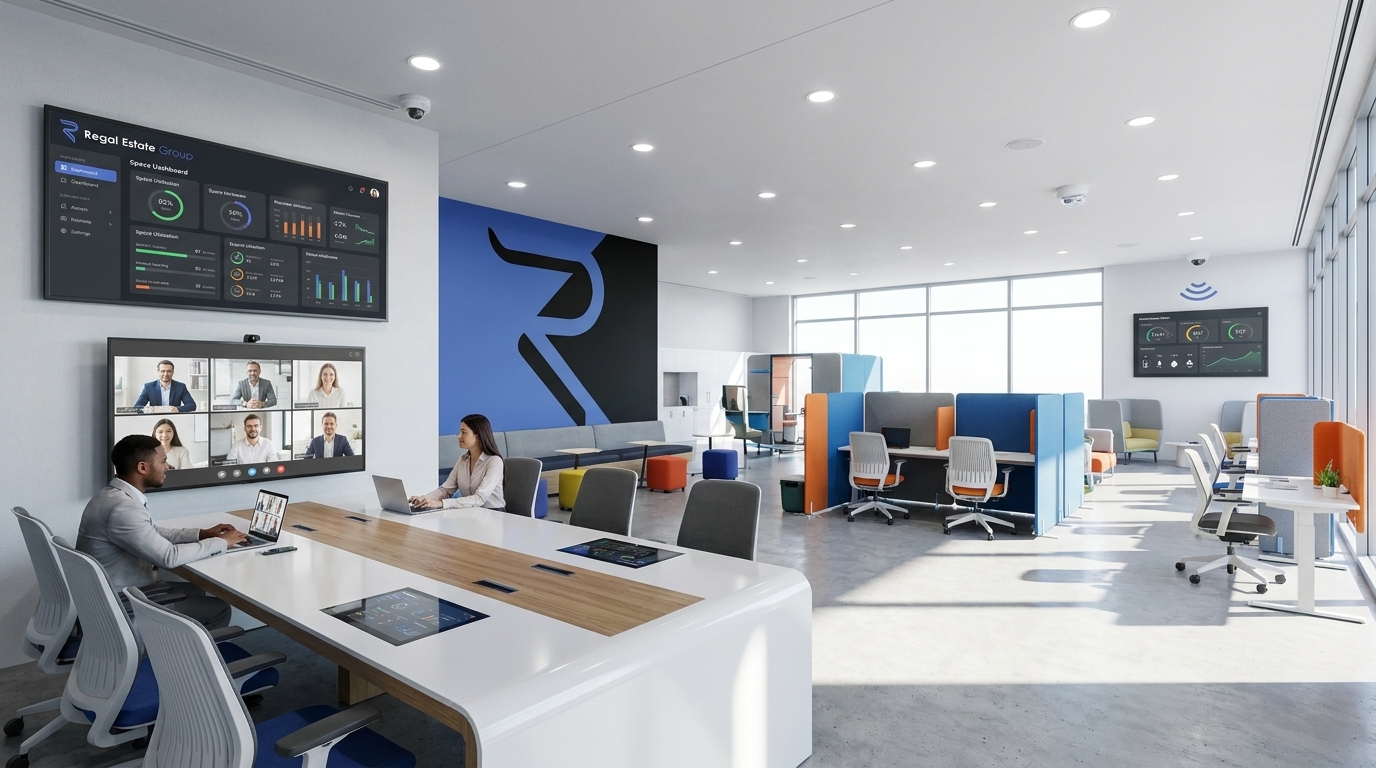
Regal Estate Group’s Instant Clarity Dashboard is designed for side-by-side location comparisons. That gives decision-makers a structured way to review options instead of relying only on scattered spreadsheets and individual property conversations.
For a deeper look at how predictive data can support operational decisions, see this related article on predictive spatial analytics.
Choose locations around your people
An office location affects more than rent. It can influence how practical it is for employees to work there and how attractive the location is during hiring.
Regal Estate Group’s Predictive Spatial Analytics capability is designed to match office locations with talent pools and commute times. This creates a more data-backed way to assess whether a location fits your workforce, rather than choosing based only on a postal address or available square footage.
Of course, analytics don’t replace judgment. You should still consider the team’s working patterns, local regulations, security requirements, and the type of environment your employees need. Data helps you ask better questions and compare options more consistently.
Enter new markets with less setup friction
A new market can bring local property research, vendor coordination, compliance questions, and infrastructure decisions. A broker-led process may also introduce additional steps between your team and the available workspace.
A platform that aggregates workspace options can give you a more direct way to search across locations. For a company entering a new region, that can make the early evaluation stage easier to organize and compare.
It doesn’t remove the need for due diligence. You still need to validate the workspace, terms, technology, security, and suitability for your team. But a clearer search and comparison process can help you move from a broad market question to a practical shortlist more efficiently.
Securing agile office space for fast-growing companies
When you’re comparing a traditional office lease with flexible workspace, start with the business question rather than the property.
- How certain are your headcount and location assumptions?
- How quickly might your space requirements change?
- What capital could be used for growth instead of office fit-out?
- What is the full monthly cost once utilities, maintenance, technology, and services are included?
- How well does each location match employee commutes and available talent?
- How much time will your leadership and operations teams spend managing the space?
If your answers point toward uncertainty, speed, and a need for clearer costs, a flexible workspace strategy may be a better fit than a large conventional commitment.
Regal Estate Group connects growing companies with flexible workspace options through a global search platform. Its all-inclusive single monthly invoicing model is designed to consolidate workspace costs into one predictable invoice, while the Instant Clarity Dashboard and Predictive Spatial Analytics support structured location comparisons.
The goal isn’t to choose flexibility for its own sake. It’s to make a real estate decision that can keep pace with your company.
To explore your options, use Regal Estate Group’s location search tool to compare flexible workspaces based on your team’s footprint, target market, and operating needs.