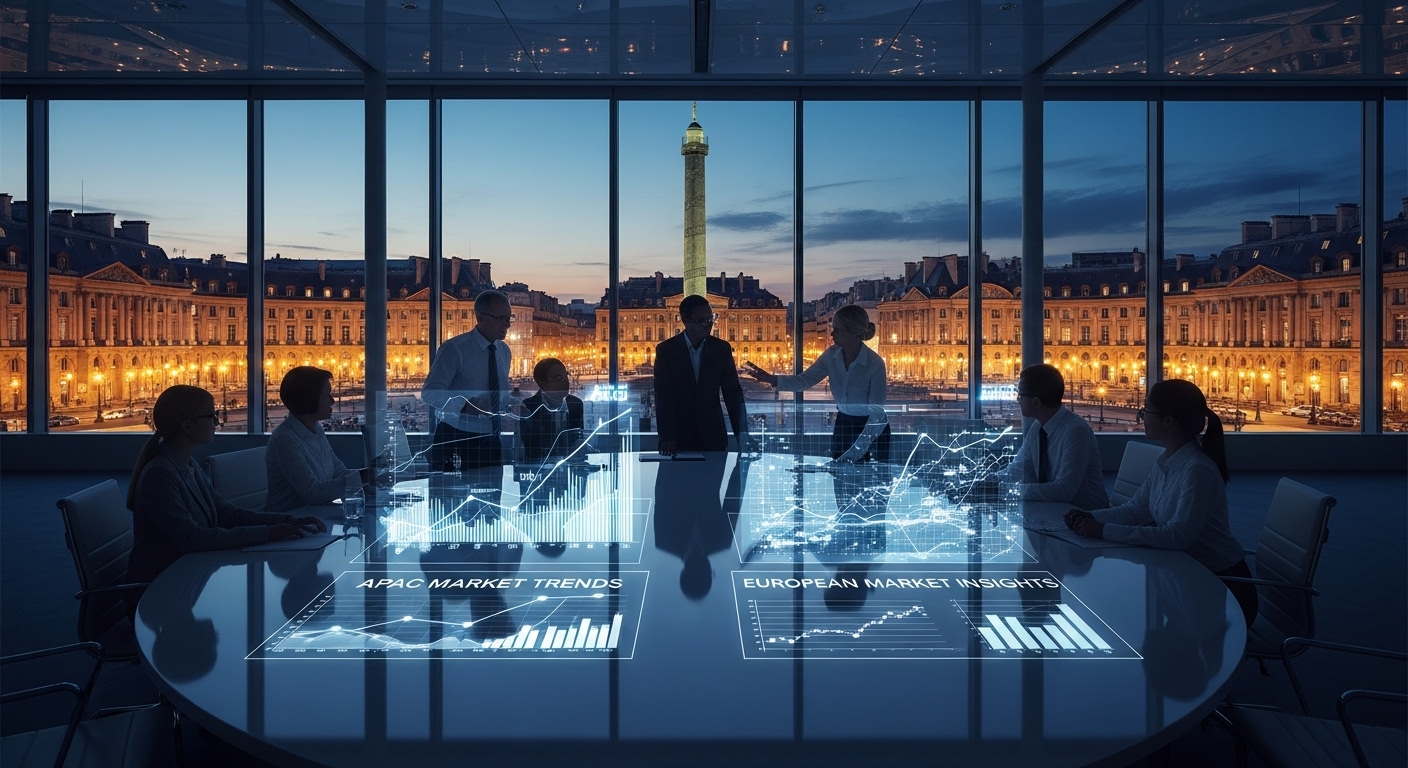
The traditional concept of the European Central Business District (CBD) is undergoing a radical transformation. No longer just a high-density cluster of corporate headquarters, the modern CBD is evolving into a dynamic, human-centric ecosystem. Driven by the global race for talent, the urgent need for sustainable practices, and the pervasive integration of technology, cities across Europe are reimagining their economic hearts. Recent trends show that sustainability is no longer a niche concern but a primary driver in real estate development, while tech infrastructure is fundamental to attracting next-generation businesses. This evolution is creating a new blueprint for the future of work, one where connectivity, well-being, and environmental responsibility are paramount. In this article, we will explore the key forces reshaping these vital urban centers, from the established giants reinventing themselves to the challenger cities making their mark on the global stage.
The enduring power of established titans: London and Paris
London’s Square Mile and Canary Wharf, alongside Paris’s La Défense, have long been the undisputed titans of European business. Their dominance was built on a foundation of immense financial capital, unrivaled global connectivity, and a deep concentration of corporate power. However, in the face of new challenges, these giants are not resting on their laurels. They are actively reinventing themselves to maintain their competitive edge. London is doubling down on its fintech and legal tech sectors, fostering innovation hubs within its historic financial center to attract a new generation of talent that values agility and a vibrant work-life balance. There’s a palpable shift from monolithic office blocks to more flexible, mixed-use spaces that incorporate retail, leisure, and green areas. Similarly, La Défense in Paris is in the midst of a monumental renewal project. The district’s leadership has laid out an ambitious goal to become the world’s first post-carbon business district. This involves retrofitting aging towers for optimal energy efficiency, promoting sustainable transport options like cycling and electric vehicles, and significantly increasing the amount of green space. This strategic pivot is not just an environmental statement but a core part of its value proposition to global corporations and the talent they seek to employ. These efforts demonstrate a clear understanding that future success depends on adapting to the new priorities of sustainability and employee well-being.
The rise of challenger hubs: Amsterdam, Dublin, and Berlin
While London and Paris evolve, a new league of challenger cities is rapidly gaining prominence, each offering a unique value proposition. Amsterdam’s Zuidas district has emerged as a premier European hub, attracting a diverse range of companies in finance, law, and tech. Its success is built on exceptional digital infrastructure, a highly skilled, multilingual workforce, and a strong emphasis on work-life balance. The district is meticulously planned, integrating modern, sustainable architecture with seamless public transport, making it a magnet for international talent. Dublin’s Silicon Docks has a different flavor, having carved out a niche as Europe’s preeminent tech hub. Home to the European headquarters of numerous global tech giants, the area is a vibrant ecosystem of innovation, fueled by a young, dynamic talent pool and a pro-business environment. The district’s energetic, campus-like feel fosters a culture of collaboration that is highly attractive to tech professionals. Meanwhile, Berlin continues to cement its reputation as a creative and startup capital. Its business districts are less centralized and more spread out, reflecting the city’s polycentric nature. Hubs like the Mediaspree and the area around Potsdamer Platz are characterized by a mix of established corporations, co-working spaces, and innovative startups, all thriving in a city known for its relatively low cost of living and high quality of life. These challenger hubs prove that a one-size-fits-all model for a CBD is obsolete; success now comes from leveraging unique local strengths to attract specific industries and talent profiles.
The green imperative: sustainability as a core strategy
Across Europe, sustainability has transitioned from a corporate social responsibility talking point to a critical, non-negotiable component of urban and business development. Stricter EU regulations, combined with intense pressure from investors and a workforce that increasingly demands environmental accountability, are forcing a green revolution in commercial real estate. The most forward-thinking business districts are now defined by their commitment to eco-friendly practices. This goes far beyond planting a few trees. It involves a holistic approach that includes the construction of certified green buildings with BREEAM or LEED certifications, the large-scale integration of renewable energy sources, and the development of circular economy principles for waste and water management. We are seeing a surge in projects that prioritize biodiversity, with green roofs, living walls, and urban parks becoming standard features. Landmark developments like Milan’s Bosco Verticale have set a new global standard, demonstrating how nature can be woven directly into the urban fabric. This focus on sustainability is not purely altruistic; it’s a powerful economic driver. Green buildings command higher rents, have lower operational costs, and are proven to enhance employee productivity and well-being. As such, a strong green credential is now one of the most powerful tools a business district can wield in the global competition for talent and investment.
The technology infusion: creating smart and connected districts
Technology is the central nervous system of the modern European business district, enabling a level of efficiency, connectivity, and intelligence that was once unimaginable. High-speed fiber optic networks are now as fundamental as any other utility, providing the backbone for a thriving digital economy. But the tech infusion goes much deeper. Cities are leveraging the Internet of Things (IoT) to create genuinely ‘smart’ districts. IoT sensors are used to manage traffic flow in real-time, optimize energy consumption in buildings, monitor air quality, and enhance public safety. This data-driven approach allows for more efficient urban management and a higher quality of life for those who work and live there. The rise of 5G is set to accelerate this trend, unlocking new possibilities for autonomous vehicles, augmented reality applications, and seamless connectivity. Furthermore, the buildings themselves are becoming smarter. Integrated systems now control lighting, climate, and security, adapting to occupancy levels and user preferences to create environments that are both comfortable and hyper-efficient. For businesses, this technological ecosystem is a powerful enabler of productivity and innovation. For the districts, it’s a critical differentiator that attracts cutting-edge companies and the tech-savvy talent they employ.
The human-centric shift: designing for people first
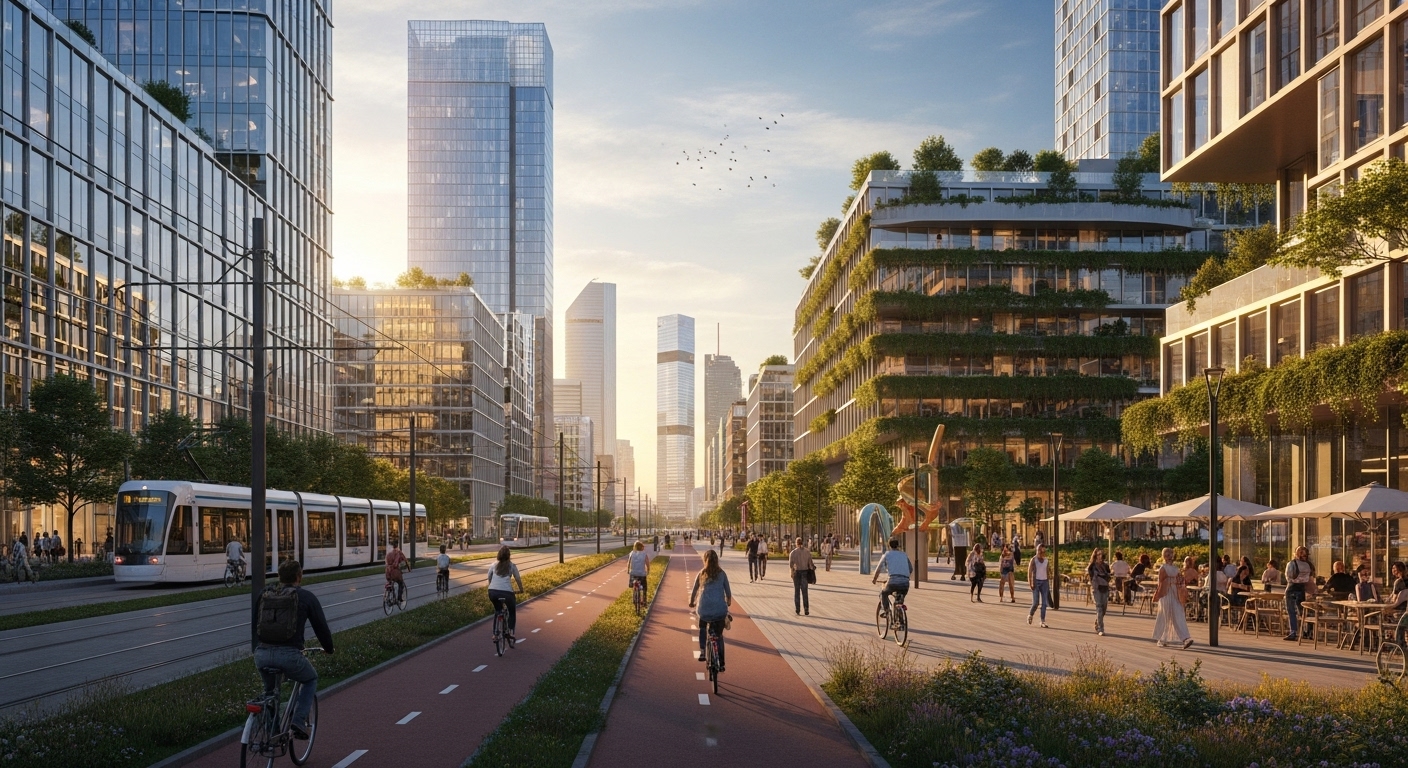
Perhaps the most significant change in the evolution of European business districts is the pivot towards a human-centric design philosophy. For decades, CBDs were designed primarily for corporate efficiency, often resulting in sterile, nine-to-five environments. Today, the focus has shifted entirely to the human experience. With executives ranking talent attraction as their top priority, districts are being reimagined as vibrant, mixed-use neighborhoods that cater to a holistic lifestyle. This means breaking down the rigid zoning of the past and creating a seamless blend of office, residential, retail, and cultural spaces. The goal is to create ’15-minute cities’ where daily needs can be met with a short walk or bike ride. Public squares, pedestrian-friendly streets, and an abundance of cafes, restaurants, and cultural venues are now seen as essential infrastructure. This approach directly addresses the demands of the modern workforce, which prioritizes flexibility, community, and well-being. The rise of hybrid work has only amplified this trend. The office is no longer just a place to work; it’s a destination for collaboration, innovation, and social connection. Therefore, the surrounding district must offer compelling reasons for employees to make the commute, transforming from a concrete jungle into a central social district where people choose to be.
The investment landscape and future outlook
The investment landscape for European business districts reflects this ongoing evolution. There is a clear ‘flight to quality,’ with investors prioritizing prime assets in districts that excel in sustainability, technology, and talent attraction. Properties with strong ESG (Environmental, Social, and Governance) credentials are in particularly high demand, as they are seen as less risky and more resilient long-term investments. While the traditional office sector faces challenges due to the rise of remote work, demand remains strong for flexible, high-spec spaces that can accommodate hybrid models and foster collaboration. Investors are also increasingly looking at mixed-use developments, recognizing the value of creating integrated communities. Looking ahead, the most successful European business districts will be those that embrace this multifaceted identity. They will function less like isolated commercial islands and more like vibrant, integrated urban neighborhoods. The competition between cities will intensify, but it will be fought not just on economic terms, but on quality of life, sustainability, and the ability to create an environment where both businesses and people can thrive. The future CBD is adaptable, green, technologically advanced, and, above all, human.
In conclusion, the European business district is at a pivotal juncture. The monolithic, purely corporate-driven model of the 20th century is being decisively replaced by a more dynamic, resilient, and appealing blueprint. The integration of sustainability is no longer optional but a core component of economic viability, attracting both investment and environmentally conscious talent. Simultaneously, the deep infusion of smart technology is creating hyper-efficient and responsive urban environments. However, the most profound shift is the focus on the human experience. By transforming into vibrant, mixed-use ‘central social districts,’ these hubs are adapting to the new realities of hybrid work and the universal demand for a better work-life balance. The cities that successfully orchestrate this complex interplay of green initiatives, technological innovation, and human-centric design—places like Amsterdam’s Zuidas and the reinvented La Défense—are not just building the business districts of the future; they are crafting the very future of urban work and life.